
Summer 2025 REU program on “Generalized Schrödinger Bridge and its Applications”
- Program duration: June. 15, 2025 – Aug. 14, 2025 (Full time)
- Location: UW-Madison (In person/online)
- Eligibility: Any current undergraduate student at UW-Madison who expects to continue enrollment in the 2024-2025 academic year.
- Stipend: Eligible students will receive a stipend of $4,000 for the 8-week program.
- Principal Investigator: Hanbaek Lyu (hlyu@math.wisc.edu)
- Application material: CV, unoffical transcript, and a brief description of why you are interested in the project.
- For full consideration, please apply by May 11, 2025.
- For questions, contact the program organizer Hanbaek Lyu (UW-Madison Math) at hlyu@math.wisc.edu.
Application link: https://docs.google.com/forms/d/e/1FAIpQLSeCXIaVqJVlmkhETf6lzSh7ZRhLPrRvuQNZCBVOvsuN6mzg5w/viewform?usp=sharing
==================
Program Description
The classical dynamic Schrödinger Bridge (dSB) problem, which seeks the most likely stochastic evolution between two marginal probability distributions, has been extensively studied in optimal transport and statistical physics, and more recently in the machine learning community due to its connections with generative modeling. The dSB is equivalent to the static Schrödinger Bridge (sSB), which can be framed as a matrix optimization problem: it seeks a matrix with prescribed row and column sums that is closest to a given reference matrix. In the classical setting, this closeness is measured using the Kullback-Leibler (KL) divergence, but the framework can be generalized to allow any strictly increasing divergence functional.
This generalized sSB framework unifies a wide range of seemingly unrelated problems, including entropic optimal transport, matrix scaling, contingency table inference, and graph realization with prescribed degree sequences. Recent advances show that Sinkhorn-type algorithms for generalized sSB problems exhibit fast linear convergence—even in settings without closed-form updates, as in the KL divergence case. These developments open the door to tailoring divergence functionals adaptively for different problem domains.
The proposed REU program will explore both practical and theoretical aspects of the generalized Schrödinger Bridge problem. On the practical side, students will begin by implementing the Diffusion Schrödinger Bridge [1] and applying it to image generation tasks, such as unpaired image translation [2, 3]. We will then extend the framework to incorporate general divergence functionals, investigating whether this added flexibility offers advantages for specific tasks. Additional experiments will include video generation in a multi-marginal Schrödinger Bridge framework.
On the theoretical side, while the generalized static SB framework connects many classical problems, their dynamic counterparts have so far been studied primarily within the original dSB setting. We will investigate the mathematical properties of dynamic generalizations of sSB in domains such as contingency tables and graphs with prescribed degree sequences.
References
[1] Valentin De Bortoli, James Thornton, Jeremy Heng, Arnaud Doucet, “Diffusion Schrödinger Bridge with Applications to Score-Based Generative Modeling“. https://proceedings.neurips.cc/paper_files/paper/2021/hash/940392f5f32a7ade1cc201767cf83e31-Abstract.html
[2] Alexander Korotin, Nikita Gushchin, Evgeny Burnaev, “Light Schrödinger Bridge”, https://arxiv.org/abs/2310.01174
[3] Jun-Yan Zhu, Taesung Park, Phillip Isola, Alexei A. Efros, “Unpaired Image-to-Image Translation using Cycle-Consistent Adversarial Networks” https://arxiv.org/pdf/1703.10593
Summer 2024 REU program on “Machine learning on Networks”
- Program duration: Jul. 1, 2024 – Aug. 31, 2024 (Full time)
- Location: UW-Madison (In person)
- Eligibility: Any current undergraduate student at UW-Madison who expects to continue enrollment in the 2024-2025 academic year.
- Stipend: Eligible students will receive a stipend of $4,000 for the 8-week program.
- Principal Investigator: Hanbaek Lyu (hlyu@math.wisc.edu)
- Application material: CV, unoffical transcript, and a brief description of why you are interested in the project.
- For full consideration, please complete the google form by April 30, 2024.
==================Program Description:
- (From REU 2022) Agam Goyal, Zhaoxing Wu, Richard P. Yim, Binhao Chen, Zihong Xu, and Hanbaek Lyu, “A latent linear model for nonlinear coupled oscillators on graphs.” Preprint (2023)
- (From REU 2020) Hardeep Bassi*, Richard Yim*, Rohith Kodukula*, Joshua Vendrow*, Cherlin Zhu*, Hanbaek Lyu, “Learning to predict synchronization of coupled oscillators on randomly generated graphs.” Scientific Reports 12, Article number: 15056 (2022) [Journal, GitHub]
Summer 2022 REU program on “Machine learning approaches to oscillator and clock synchronization”
- PI: Hanbaek Lyu (Department of Mathematics, UW-Madison; hlyu@math.wisc.edu)
- Program support: NSF Grant DMS-2010035
- Program duration: Jul. 1, 2022 – Aug. 31, 2022 (Full time)
- Location: UW-Madison (In person)
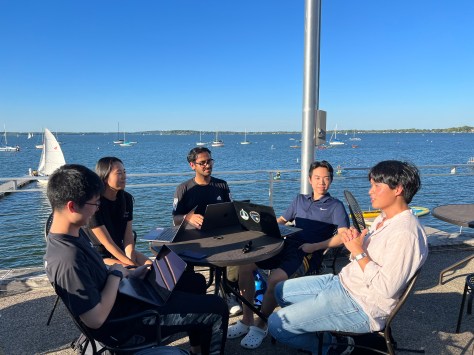
- Participants: Bella Wu (Stats), Agam Goyal (CS), Binhao Chen (Math), Bryan Xu (Math)
- Project Report REU2022
- Slides: Interpretable_ML_for_Synchronization
Program Description:
If a group of people is given local clocks with arbitrarily set times, and there is no global reference (for example GPS), is it possible for the group to synchronize all clocks by only communicating with nearby members? In order for a distributed system to be able to perform high-level tasks that may go beyond the capability of an individual agent, the system must first solve a “clock synchronization” problem to establish a shared notion of time. The study of clock synchronization (or coupled oscillators) has been an important subject of research in mathematics and various areas of science for decades, with fruitful applications in many areas including wildfire monitoring, electric power networks, robotic vehicle networks, large-scale information fusion, and wireless sensor networks. However, there has been a gap between our theoretical understanding of systems of coupled oscillators and practical requirements for clock synchronization algorithms in modern application contexts. This project will develop systematic approaches for bridging this gap based on combinatorial, probabilistic, and machine learning methods.
Suppose we are given a system of coupled oscillators on an unknown graph along with the trajectory of the system during some short period. Can we predict whether the system will eventually synchronize? Even with known underlying graph structure, this is an important but analytically intractable question in general. In a paper resulted from a past REU project (in 2022 virtually at UCLA, see https://arxiv.org/pdf/2012.14048.pdf), we take a novel approach that we call “learning to predict synchronization” (L2PSync), by viewing the synchronization prediction problem as a classification problem for sets of initial dynamics into two classes: ‘synchronizing’ or ‘non-synchronizing’. While a baseline predictor using concentration principle misses a large proportion of synchronizing examples, standard binary classification algorithms trained on large enough datasets of initial dynamics can successfully predict the unseen future of a system on highly heterogeneous sets of unknown graphs with surprising accuracy. In addition, we find that the full graph information gives only marginal improvements over what we can achieve by only using the initial dynamics.
In the upcoming REU project that will be held in summer 2022 at UW-Madison (in person), we will investigate various open problems in related topics. One of the main open questions is why/how simple classification algorithms significantly outperforms what oscillator theory predicts. What kind of separation between synchornizing and non-synchronizing examples do they see? Can we (human) learn what machine learning algorithms learned from a massive amount of data and use it to advance our theoretical understanding of coupled oscillators? A possible approach is to use yet another class of machine learning methods of supervised feature extraction to let them tell us what they see.
During the 8-weeks long summer REU 2020 project, the team will take an interdisciplinary approach to the problem of oscillator and clock synchronization using some of the modern machine learning techniques and a family of discrete oscillators due to the PI (called the Firefly Cellular Automata) as well as the standard continuous model called the Kuramoto oscillators.
Minimum experience in python programming and dynamical systems is required.
==================================================
- PI: Hanbaek Lyu (Department of Mathematics, UCLA; hlyu@math.ucla.edu)
- Program support: NSF Grant DMS-2010035
- Program duration: June 1, 2020 – Aug. 1, 2020 (Full time)
- Location: Online
- Participants: Hardeep Bassi, Richard Yim, Rohith Kodukula, Joshua Vendrow, Cherlin Zhu
- Hardeep Bassi*, Richard Yim*, Rohith Kodukula*, Joshua Vendrow*, Cherlin Zhu*, Hanbaek Lyu, “Learning to predict synchronization of coupled oscillators on randomly generated graphs.” To appear in Scientific Reports [Preprint, GitHub] (2020)
PI: Hanbaek Lyu
If a group of people is given local clocks with arbitrarily set times, and there is no global reference (for example GPS), is it possible for the group to synchronize all clocks by only communicating with nearby members? In order for a distributed system to be able to perform high-level tasks that may go beyond the capability of an individual agent, the system must first solve a “clock synchronization” problem to establish a shared notion of time. The study of clock synchronization (or coupled oscillators) has been an important subject of research in mathematics and various areas of science for decades, with fruitful applications in many areas including wildfire monitoring, electric power networks, robotic vehicle networks, large-scale information fusion, and wireless sensor networks. However, there has been a gap between our theoretical understanding of systems of coupled oscillators and practical requirements for clock synchronization algorithms in modern application contexts. This project will develop systematic approaches for bridging this gap based on combinatorial and probabilistic methods. The use of discrete oscillators will be a key thread in developing more robust and efficient clock synchronization algorithms, extending the current proof techniques for convergence guarantee, and providing a foundation for a data-driven approach to the clock synchronization problems.
During the 8-weeks long summer REU 2020 project, the team will take an interdisciplinary approach to the problem of oscillator and clock synchronization using some of the modern machine learning techniques and a family of discrete oscillators due to the PI (called the Firefly Cellular Automata).
Minimum experience in python programming and dynamical systems is required.
 Hanbaek Lyu